REGISTER HERE AT THIS LINK, BY CALLING 320-634-5327, OR EMAIL KATHERINE.DISRUD@MN.NACDNET.NET:
https://docs.google.com/forms/d/e/1FAIpQLSdjEmHwPNeo5sAD9RXOtJN6eMPmHlG45bkgaWYD7xGVWn1LEw
Providing Quality Conservation Resources since 1949
REGISTER HERE AT THIS LINK, BY CALLING 320-634-5327, OR EMAIL KATHERINE.DISRUD@MN.NACDNET.NET:
https://docs.google.com/forms/d/e/1FAIpQLSdjEmHwPNeo5sAD9RXOtJN6eMPmHlG45bkgaWYD7xGVWn1LEw

Pope Soil and Water Conservation District will be hosting a free water testing clinic Friday, August 1st from 12:00 pm to 4:00 pm at the Pope County Fair. Bring your water sample to the Pope SWCD booth in the Industrial Building at the fairgrounds for a free nitrate analysis. To receive the best results, collect a minimum of one-half cup of water in a clean container within two hours of testing. Water should be at room temperature for testing.
Nitrogen exists in the environment in both organic and inorganic forms. When in its inorganic form, it is an essential element to plants. However, when considering water quality, nitrogen becomes a concern when in its nitrate form. Excessive nitrate concentrations in groundwater can be hazardous to human and environmental health. High levels of nitrates can affect how blood carries oxygen in the body. The Environmental Protection Agency (EPA) has set 10 mg/L as the maximum contaminant level for nitrate-nitrogen in drinking water. The Minnesota Department of Health recommends that private wells are tested for nitrates every 1-2 years. If nitrates have been previously detected or if an infant under six months will be consuming the water, testing should be conducted more frequently.
Nitrates most commonly enter groundwater through leaching or draining. Because nitrate does not attach to soil particles, it is easily moved by water filtering through the soil. The contamination can result from both human causes and natural sources. Although both can lead to hazardous conditions, it is often human caused sources that force nitrate concentrations into dangerous levels. Sources include fertilizer application, manure storage, and sewage disposal. Some primary factors that have an effect on nitrogen leaching include nitrogen rate and sources, application timing, irrigation practices, age of site, and soil texture. There are home water treatment units that can help remove nitrates from your drinking water. However, prevention of nitrogen loss is the preferred method of reducing nitrate concentrations in groundwater.
Did you know…
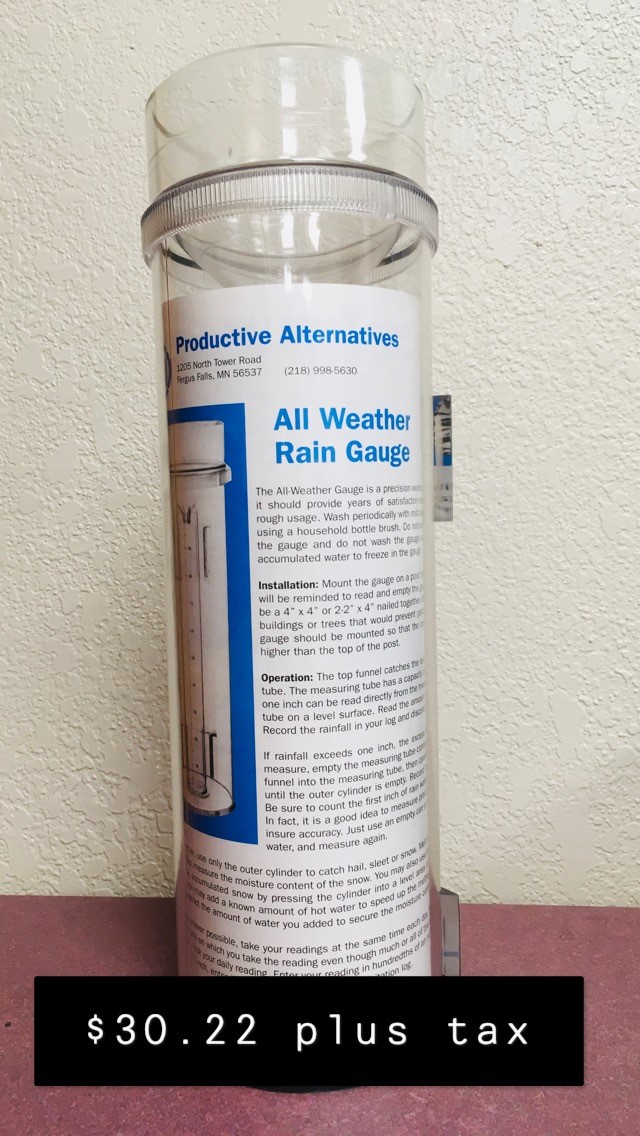
In Minnesota, yearly precipitation can range anywhere from 18 to 32 inches. An All Weather Rain Gauge can be used in any season to collect and measure precipitation. It is easily installed on any wooden post in an open space.
To check the amount of precipitation, look at the amount in the measuring tube. If it exceeds an inch, then the excess can be found in the outer cylinder and can be measured by dumping out the first inch from the measuring tube and carefully pouring in the excess to measure. The gauge can be used in the colder season by using the outer cylinder to collect hail, sleet, and snow. Then when ready to measure, bring indoors to melt and then measure using the measuring tube.
By checking and logging the precipitation collected in your All Weather Rain Gauge every day you can make more accurate predictions about precipitation in your area.
Have kids and teens at home for the summer? Teaching your kids how to use the gauge and adding it into their daily routine can be a fun way for them to learn more about the environment and the water cycle. The rain gauge can give valuable information for farmers, novice gardeners, or anyone who’s curious about the amount of rain falling on their property.
If you are also interested, you could become a rainfall monitor for our precipitation network. Call and ask for Kimberly at 320-634-5327.
You can purchase a All Weather Rain Gauge at Pope SWCD for $30.22 plus tax.